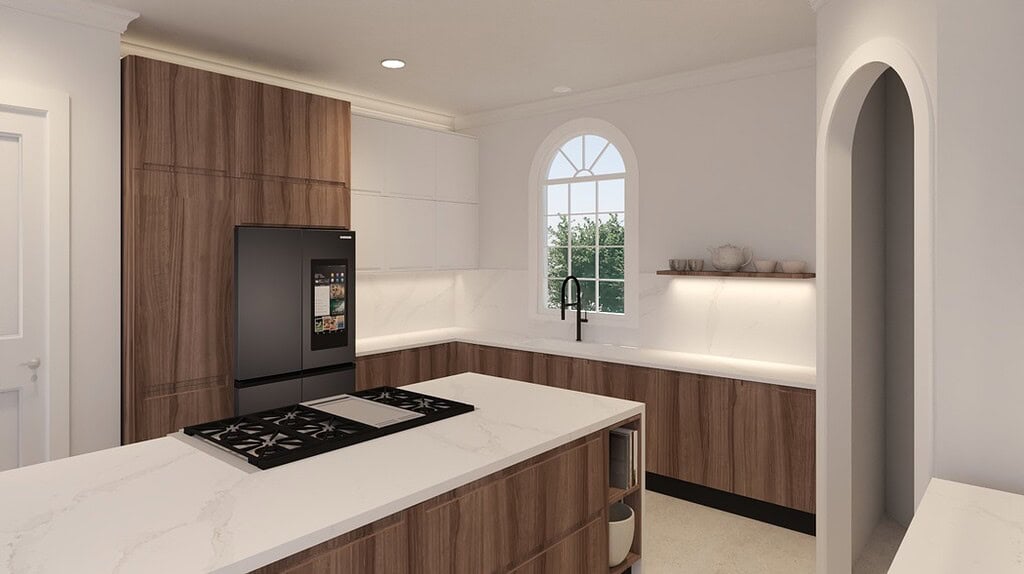
Few elements interrupt a minimalist kitchen as much as the cooktop. Even the sleekest glass induction hob is a dark rectangle set into the counter. The invisible induction cooktop removes it entirely. Installed beneath the countertop, it turns an uninterrupted slab of porcelain into a cooking surface, then returns it to a clean work or serving area when the meal is done.
It is one of the most striking innovations in modern kitchen technology, and also one that rewards careful planning. Here is how invisible cooktops work, what they require and whether one is right for your kitchen.
How an Invisible Induction Cooktop Works
Conventional induction uses electromagnetic fields to heat magnetic cookware directly; the glass surface itself is not the heat source. An invisible, or hidden, induction cooktop applies the same principle, but the induction unit is mounted beneath a compatible countertop instead of being set into a cutout.
The electromagnetic field passes through the countertop material and heats the pan. Cooking zones are typically indicated by subtle markings or a template, and the system is controlled through a discreet touch panel, a control knob or, with some systems, a mobile app.
Why Luxury Homeowners Are Choosing Hidden Cooktops
- Uninterrupted surfaces: the countertop reads as one continuous slab, ideal for minimalist kitchen design and statement islands.
- Multifunctional space: when not cooking, the zone serves as prep, serving or dining space.
- Easy cleaning: no edges, trims or cutouts to collect grease and crumbs.
- Architectural consistency: it complements panel-ready refrigeration, handleless fronts and concealed ventilation in a fully integrated kitchen.
Invisible cooktops are a natural part of the broader hidden kitchen movement.
The Countertop Is the Critical Decision
An invisible induction system only works with countertops approved by its manufacturer. In most cases, that means large-format porcelain or sintered stone of a specified thickness, materials that tolerate the heat transferred from hot cookware and allow the magnetic field to pass through efficiently.
- Porcelain and sintered stone: the usual compatible surfaces. Many are available in marble-look, stone-look and solid colors.
- Quartz (engineered stone): generally not recommended, because the resins in quartz can be damaged by sustained heat.
- Natural stone: generally not specified for these systems because of variability in composition, thickness and heat behavior.
- Wood and laminate: not suitable.
Always confirm the specific countertop brand, finish and thickness with the cooktop manufacturer. Choosing the system and the slab together, early in the design, avoids costly surprises.
Performance: What to Expect
Invisible cooktops are capable of everyday cooking, including boiling, searing and simmering. Because the induction unit sits beneath the slab rather than directly under thin glass, performance can differ from a conventional premium induction hob, depending on the system. Serious cooks should compare power levels and responsiveness, and consider pairing an invisible zone with a conventional cooktop or range elsewhere in the kitchen.
As with all induction cooking, cookware must be magnetic. Cast iron and most stainless steel work; aluminum, copper and glass typically do not unless they have a magnetic base.
Safety and Surface Care
- The surface gets warm. Induction does not heat the countertop directly, but heat transfers back from the hot pan. Treat the zone as hot after cooking.
- Follow protective guidance. Many manufacturers recommend or supply protective mats, spacers or pads between the cookware and surface. Follow these instructions to protect the slab.
- Safety features. Systems typically include pan detection, automatic shutoff and overheat protection; features vary by brand.
- Mark the zones. Subtle etched or printed markings help family members and guests know where cooking happens.
- Medical devices. As with any induction appliance, people with pacemakers or implanted devices should consult their physician and the manufacturer’s guidance.
Cabinetry, Power and Ventilation Planning
Cabinetry Below
The induction unit occupies space beneath the countertop and needs airflow to stay cool. Drawers and cabinets below must be designed around the unit’s dimensions and ventilation requirements, and access for servicing should be considered.
Electrical
Like other induction cooktops, these systems usually require a dedicated high-amperage circuit. Coordinate the electrical rough-in with the cabinet drawings.
Ventilation
A hidden cooktop still produces steam, smoke and cooking odors. Plan ventilation alongside it: a ceiling-integrated hood, a downdraft system or a hood concealed within upper cabinetry. On islands, ceiling hoods are often the most discreet option.
Countertop Fabrication
The fabricator must follow the system’s installation requirements, including slab thickness, support and the placement of zone markings. Coordination between cooktop supplier, fabricator and cabinet designer is essential.
Where Invisible Cooktops Work Best
- Kitchen islands, where an uninterrupted slab makes the strongest impression
- Open-plan kitchens visible from the living room
- Secondary kitchens and bars used for light cooking and serving
- Minimalist and hidden kitchens built around concealed appliances
Is an Invisible Cooktop Right for You?
It may be a good fit if you:
- Value a seamless, architectural kitchen
- Are planning a new porcelain or sintered stone countertop
- Cook regularly but do not require the absolute highest output for every dish
- Are comfortable following care guidance for the surface
It may be less suitable if you prefer gas cooking, want a natural stone or quartz countertop in the cooking area, or are not replacing your countertops.
How Foscari Fits In
Foscari Interiors’ design team coordinates cooking appliances with cabinetry and countertops during design, so cabinet interiors, ventilation openings, electrical locations and slab specifications align. If you are considering an invisible cooktop, we will factor its requirements into the cabinetry design from the start. Learn about our approach on the kitchen design page, or explore materials in our Houston showroom.
Frequently Asked Questions
What is an invisible induction cooktop?
An induction cooking system installed beneath a compatible countertop, usually porcelain or sintered stone, so the cooking surface is part of the slab rather than a separate cooktop.
Can I install an invisible cooktop under quartz or granite?
Generally not. Most systems are approved only for specific porcelain or sintered stone surfaces. Check with the manufacturer before selecting materials.
Does the countertop get hot?
The area under the pan becomes warm from contact with hot cookware. It cools after cooking, but should be treated as hot in the meantime.
Do I still need a range hood?
Yes. Ventilation is still required to remove steam, smoke and odors.
Can it be added to an existing kitchen?
Usually only when the countertop is being replaced with a compatible material, since the slab and system must be planned together.
Related reading: Luxury Kitchen Island Ideas, Luxury Kitchen Design Trends for 2027 and Countertop Materials for Modern Cabinets.
Plan a Seamless Kitchen
An invisible cooktop is most successful when it is part of a fully considered design. Request a design consultation and our team will help you weigh the options.
Foscari Interiors
2226 Richmond Ave.
Houston, TX 77098