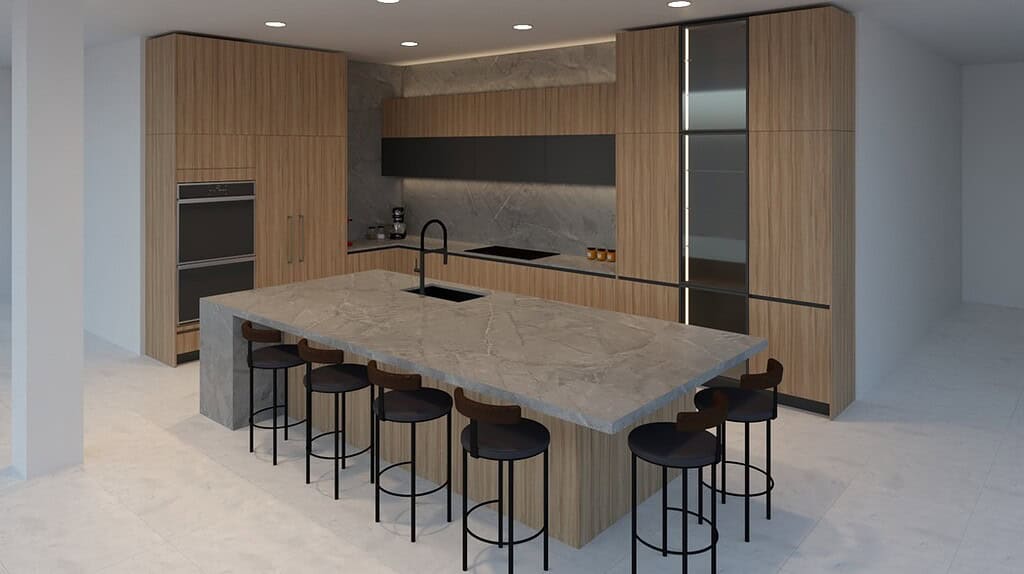
Once the layout of a kitchen is settled, attention turns to the details people see and touch every day: cabinet doors, finishes and hardware.
These choices define the character of the room. The same layout can feel warm and residential, crisp and architectural, or rich and dramatic depending on the door profile, the material and the way cabinets open.
They also affect durability, maintenance and how the cabinetry ages.
This guide explains the main options for cabinet door styles, finishes and hardware and how to choose combinations that suit the architecture of your Houston home.
1. Choose in the Right Order
Selections are easier when made in a sensible sequence:
- Layout and cabinet configuration
- Door style
- Primary cabinet finish
- Secondary or accent finishes
- Countertops and backsplash
- Hardware and opening system
Door style and finish should be considered alongside countertops and flooring, since they will be seen together. Hardware is best chosen once the door and finish are established so it can be scaled and coordinated appropriately.
2. Slab Doors
A slab door is a single flat panel with no frame or profile.
Slab doors are the foundation of most contemporary and European kitchens. Their simplicity places emphasis on material, proportion and alignment.
Because there is no decorative profile, the finish does most of the visual work. A slab door in walnut veneer, matte lacquer or textured laminate can create very different moods.
Slab doors also make consistent reveals and alignment especially visible, which is why precision matters in contemporary cabinetry.
3. Shaker and Recessed-Panel Doors
A Shaker door has a flat recessed center panel surrounded by a simple frame.
It is one of the most versatile door styles, suitable for traditional, transitional and relaxed contemporary interiors. Narrow-frame versions can feel quite modern, while wider frames read as more traditional.
Shaker doors are often associated with painted finishes, but they also work in wood.
4. Inset Doors
Inset doors sit within the cabinet frame so the door face is flush with the frame, rather than overlaying it.
They create a refined, furniture-like appearance associated with traditional and transitional kitchens. Inset construction requires careful fitting because the gaps around each door are visible.
For a comparison of framed and frameless construction, see Frameless vs. Face-Frame Cabinets.
5. Glass and Framed Doors
Glass doors introduce display and visual lightness.
Options include clear, fluted, reeded, tinted and frosted glass, often set in slim metal or wood frames.
Glass works well for glassware, serving pieces and selected objects, and can lighten a long run of upper cabinetry. It should be used selectively, since glass-front cabinets display whatever is stored inside them.
Interior cabinet lighting can make glass-front cabinetry particularly effective.
6. Fluted, Ribbed and Textured Doors
Fluted and ribbed doors add vertical rhythm and texture without traditional ornament.
They can be used across an entire island, on a feature wall or as an accent within an otherwise simple kitchen.
Textured surfaces can also be introduced through wood grain, embossed finishes or technical materials. Texture adds depth, particularly in kitchens with a restrained color palette.
7. Wood Veneer
Wood veneer is a thin layer of real wood applied to a stable core.
Veneer allows natural wood to be used on large, flat doors with greater dimensional stability than solid wood panels. It also allows grain to be matched or continued across adjacent doors.
Common species include oak, walnut and ash, and each can be finished in many tones. Grain can run vertically to emphasize height or horizontally to emphasize length.
Wood brings warmth to contemporary kitchens and pairs well with stone, metal and matte finishes.
8. Matte and Gloss Lacquer
Lacquer finishes provide a smooth, uniform surface in almost any color.
Matte lacquer creates a calm, soft appearance that suits minimal and architectural kitchens. High-gloss lacquer reflects light and creates a more dramatic, polished effect but shows fingerprints and marks more readily.
Lacquer can also be color-matched to coordinate with walls, flooring or other elements in the home.
9. Laminates and Technical Surfaces
High-quality laminates and technical surfaces have become far more sophisticated than the laminates of the past.
Many contemporary options offer realistic wood, stone or textured finishes and can be very durable. Some technical materials, such as Fenix-type surfaces, offer matte, soft-touch finishes designed to resist fingerprints.
These materials can be a practical choice for high-use areas, families with children and secondary spaces such as laundry rooms and sculleries.
10. Combining Finishes
Many successful kitchens use two, or at most three, cabinet finishes.
Common strategies include:
- A wood island with lighter perimeter cabinetry
- Tall cabinetry in one finish and base cabinets in another
- A single finish throughout, with glass or open shelving as an accent
- A darker lower finish with lighter upper cabinetry to lift the room
The finishes should relate through undertone and proportion. Too many unrelated finishes can make a kitchen feel fragmented.
11. Durability and Maintenance
Different finishes wear differently.
Consider:
- How easily fingerprints show
- Resistance to scratches and impacts
- How the finish responds to moisture and cleaning products
- Whether minor damage can be repaired
- How natural materials change in color over time
High-traffic areas such as the sink base, trash pull-out and island ends deserve particular attention. A finish that is perfect for a formal living room may not be the best choice beside a heavily used dishwasher.
12. Knobs, Pulls and Edge Pulls
Hardware is both functional and decorative.
Options include:
- Knobs: compact and often used on doors in traditional or transitional kitchens
- Bar pulls: versatile and easy to grip, suitable for drawers and doors
- Appliance pulls: larger pulls for panel-ready refrigerators and tall doors
- Edge pulls: slim profiles mounted to the top or side edge of the door for a minimal look
- Integrated pulls: profiles machined into or attached along the door itself
Scale matters. Pulls should be proportioned to the doors and drawers they serve, and consistent in placement across the elevation.
13. Handleless Systems
Handleless cabinetry removes visible hardware entirely, creating uninterrupted surfaces.
This can be achieved with recessed channels between drawers, push-to-open mechanisms or electronically assisted opening.
Handleless kitchens look exceptionally clean but should be evaluated for everyday usability. Push-to-open doors can be pressed accidentally, and channels need to be comfortable to grip. Testing the systems in a showroom before committing is worthwhile.
14. Hinges, Runners and Lift Systems
The mechanisms inside the cabinet are as important as the finish outside.
High-quality hinges, full-extension soft-close drawer runners and well-engineered lift systems for upper cabinets affect how the kitchen feels every time it is used.
Large drawers carrying cookware need runners rated for the load. Tall doors and wide lift-up doors need appropriate hardware to operate smoothly.
15. Coordinating Metal Finishes
Kitchens often include several metal finishes: cabinet hardware, faucets, lighting, appliance handles and trim.
These do not need to match exactly, but they should be chosen together. A deliberate combination of two metal finishes can add depth. Several unrelated finishes usually looks accidental.
Consider how metals relate to the cabinet finish. Warm metals often pair well with wood, while darker or brushed finishes can sharpen a light, minimal kitchen.
16. Evaluating Samples and Renderings
Small samples can be misleading. Finishes look different in large areas, in different light and beside other materials.
Useful approaches include:
- Viewing larger samples or full doors in a showroom
- Looking at finishes in both daylight and evening light
- Placing cabinet, countertop and flooring samples together
- Reviewing 3D renderings that show the combination at room scale
Renderings are particularly helpful for understanding how a finish combination will look across an entire kitchen before anything is ordered.
17. Common Selection Mistakes
Choosing from a tiny sample
Finishes often look different at full scale.
Using too many finishes
Two or three coordinated finishes usually work better than several unrelated ones.
Picking hardware before the door
Hardware should be scaled and coordinated to the chosen door and finish.
Ignoring maintenance
High-gloss and very dark finishes show fingerprints and dust more readily.
Committing to handleless without testing
Opening systems should be tried in person before they are specified throughout the kitchen.
18. Cabinet Design With Foscari Interiors
Foscari Interiors provides cabinet design in Houston with detailed 3D renderings that allow clients to see door styles, finishes and hardware together before cabinetry goes into production.
Our showroom offers a wide range of contemporary finishes, including wood veneers, matte and gloss lacquers, textured surfaces, glass and metal accents, from European and North American cabinetry manufacturers.
Choosing finishes for a Houston kitchen? Contact Foscari Interiors to review materials and see your design in 3D.
Frequently Asked Questions About Cabinet Doors and Finishes
What is the most popular cabinet door style for modern kitchens?
Slab doors are the foundation of most contemporary and European kitchens because they emphasize material and proportion. Narrow-frame Shaker doors are popular in transitional kitchens.
Is wood veneer as good as solid wood?
High-quality veneer uses real wood on a stable core, which can make large flat doors more dimensionally stable than solid wood panels while still showing natural grain.
Is matte or gloss cabinetry easier to maintain?
Matte finishes generally show fingerprints and small marks less than high-gloss finishes, although performance varies by product.
Are handleless kitchen cabinets practical?
They can be very practical when the opening system suits how the kitchen is used. Testing channel pulls and push-to-open systems in person is recommended.
Should cabinet hardware match the faucet?
Not necessarily. Metals should be chosen together, but a deliberate combination of finishes can work well.
Can I see my finishes in 3D before ordering?
Yes. Foscari Interiors provides 3D renderings as part of its cabinet design process.
Related reading: European Kitchen Cabinets: What Makes Them Different From American Cabinetry? and Kitchen Showroom Checklist: What to Compare Before Choosing Cabinets.
Visit the Foscari Interiors Houston showroom to compare door styles, finishes and hardware in person.
Foscari Interiors
2226 Richmond Ave.
Houston, TX 77098
Schedule a consultation to begin selecting your cabinetry.