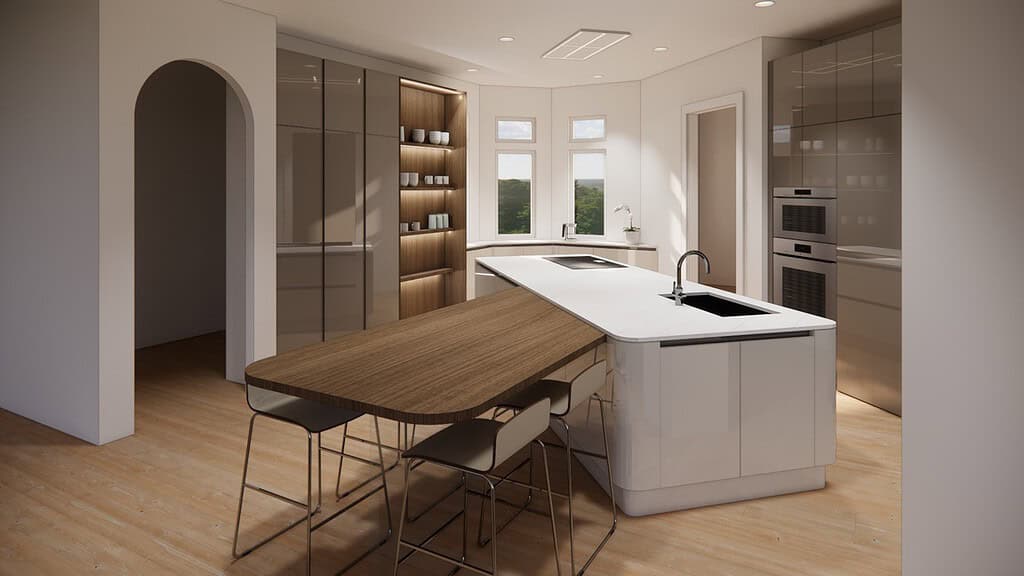
European kitchens are frequently recognized by their clean lines, integrated appliances, restrained material palettes, and highly organized cabinetry. Yet the term “European kitchen” is often used so broadly that it can be difficult for homeowners to determine what it actually means.
Is European cabinetry simply modern cabinetry? Does it need to be manufactured in Europe? Is frameless construction the defining characteristic? And are European cabinets necessarily better than cabinets made in the United States?
The answers are more nuanced than the terminology suggests.
European kitchen cabinetry is associated with a particular approach to cabinet construction and kitchen planning, but it also reflects a broader design philosophy. Space is generally used deliberately. Appliances are often integrated into the cabinetry. Storage is carefully organized. Materials are treated as architectural surfaces, and unnecessary visual interruptions are minimized.
For Houston homeowners comparing European kitchen cabinets with more traditional American cabinetry, understanding these differences is far more useful than deciding which style is “better.”
The appropriate system depends on the architecture of the home, the desired appearance, the appliances being specified, the homeowner’s storage requirements, and the level of customization expected from the kitchen.
1. What Is a European Kitchen?
A European kitchen is not defined by a single door style, finish, or color palette.
The term generally refers to kitchens influenced by European cabinet construction and design principles, particularly those developed by Italian, German, and other continental European manufacturers.
Several characteristics are commonly associated with this approach:
- Frameless cabinet construction
- Clean cabinet elevations
- Consistent reveals between doors and drawers
- Integrated or concealed appliances
- Large drawers rather than extensive lower-door cabinetry
- Full-height storage
- Handleless or minimal hardware systems
- Highly organized cabinet interiors
- Architectural use of materials
- Precise dimensional planning
However, a European kitchen does not need to be stark, white, or aggressively minimalist.
Contemporary European kitchens may incorporate natural oak, walnut, stone, metal, glass, textured finishes, warm neutrals, and rich colors.
The defining characteristic is often less about a specific aesthetic and more about the way cabinetry, appliances, storage, and architecture are considered as a unified system.
2. What Is Frameless Cabinet Construction?
One of the clearest technical distinctions associated with European cabinetry is frameless construction.
Traditional framed cabinets have a face frame attached to the front of the cabinet box. Doors and drawers are mounted in relation to that frame.
A frameless cabinet eliminates the face frame. The cabinet doors attach directly to the cabinet box using concealed hinges.
This construction method is sometimes called “full-access cabinetry” because eliminating the face frame creates a relatively unobstructed cabinet opening.
Frameless construction also contributes to the visual character associated with European kitchens. Because doors and drawer fronts can cover most of the cabinet structure, the finished elevation reads as a series of clean surfaces separated by controlled gaps.
This makes precision particularly important.
Small inconsistencies in alignment are more noticeable when the design depends on uninterrupted horizontal and vertical lines.
3. How Does Traditional American Cabinetry Differ?
Traditional American kitchen cabinetry has historically relied heavily on framed construction, although frameless cabinets are now widely manufactured in the United States as well.
Framed cabinets can support many different aesthetics, including inset doors, partial-overlay doors, and full-overlay doors.
They remain particularly appropriate for kitchens where visible frame details are part of the desired architectural character.
For example, inset cabinetry can be highly effective in traditional and transitional interiors because the relationship between the door and face frame becomes an intentional design detail.
The distinction is therefore not that European construction is inherently modern and American construction inherently traditional.
Rather, the two approaches begin with different cabinet structures, and those structures influence proportions, door relationships, interior access, detailing, and the overall appearance of the kitchen.
4. Does Frameless Cabinetry Provide More Storage?
Frameless cabinetry can provide more accessible interior space because there is no face frame partially obstructing the cabinet opening.
The practical difference is especially noticeable in drawers and narrower cabinets.
However, cabinet construction alone does not determine whether a kitchen provides effective storage.
A poorly organized frameless kitchen can be less useful than a thoughtfully planned framed kitchen.
The greater advantage comes from combining full-access construction with appropriate drawer widths, interior organizers, tall storage, appliance planning, and deliberate placement of everyday items.
For homeowners, usable storage is more important than theoretical cabinet volume.
A kitchen should make frequently used objects easy to see, reach, remove, and return.
5. Why European Kitchens Look Different
Many European kitchens have a distinctly architectural appearance because the individual cabinet is visually deemphasized.
Instead of seeing a series of separate cabinet boxes, the homeowner sees larger compositions: a wall of tall cabinetry, a continuous bank of drawers, an island volume, or an uninterrupted material surface.
This effect is achieved through several details working together:
- Minimal visible hardware
- Consistent door and drawer alignment
- Integrated appliances
- Reduced use of decorative moldings
- Full-height cabinetry
- Controlled material transitions
- Consistent reveals
The result can be visually simple, but producing that simplicity requires considerable planning.
A minimal kitchen gives the designer fewer decorative elements with which to disguise dimensional compromises. Proportion and alignment become much more important.
6. Handleless Kitchen Cabinetry
Handleless cabinetry is strongly associated with modern European kitchen design, although not every European kitchen is handleless.
Several systems can create this appearance.
Integrated channels
A recessed channel allows the user to grip the edge of the door or drawer without applying a separate handle.
Integrated edge pulls
A discreet profile may be incorporated into the cabinet front, creating a minimal appearance while retaining a physical grip.
Push-to-open systems
Doors or drawers open when pressure is applied to the front. These systems create exceptionally clean surfaces but should be selected according to the way the cabinet will be used.
Electronic opening systems
Motorized mechanisms can assist with certain drawers, doors, or waste systems, particularly where a touch-operated solution is useful.
The correct choice should be based on ergonomics as well as appearance.
A completely handleless kitchen may look exceptionally clean, but homeowners should understand how each cabinet will actually open before committing to the system.
7. Integrated Appliances
One of the most recognizable characteristics of a European kitchen is the integration of appliances into the cabinetry.
Panel-ready refrigerators and dishwashers can be concealed behind fronts that coordinate with adjacent cabinetry.
Ovens, coffee machines, warming drawers, and other appliances can be grouped within carefully organized tall cabinet elevations.
The objective is not necessarily to hide every appliance.
Rather, appliances are treated as part of the composition instead of being positioned independently after the cabinetry has been designed.
This requires early appliance selection.
Each appliance has specific dimensional, ventilation, electrical, plumbing, and clearance requirements. Cabinetry needs to be designed around those requirements while maintaining the desired visual alignment.
For homeowners considering a highly integrated kitchen, appliance and cabinetry planning should therefore occur simultaneously.
8. Full-Height and Tall Cabinetry
European kitchens frequently make extensive use of tall cabinetry.
A continuous wall of full-height cabinets can consolidate numerous functions into a relatively compact footprint.
One elevation might contain:
- Refrigeration
- Freezer storage
- Wall ovens
- Pantry storage
- Coffee equipment
- Small appliances
- Cleaning storage
Grouping these elements can leave other portions of the kitchen visually quieter.
For example, a kitchen may use one highly functional wall of tall cabinetry while allowing a window wall to remain relatively open.
The approach can be particularly effective in open-plan homes because it allows the kitchen to read as an intentional architectural element from adjoining living spaces.
9. European Kitchen Storage and Organization
Efficient storage is central to European kitchen planning.
Rather than maximizing the number of cabinets, the objective is generally to make each cabinet perform a clear function.
Interior systems may organize:
- Cutlery
- Cooking utensils
- Spices
- Cookware
- Plates and bowls
- Food storage containers
- Waste and recycling
- Cleaning supplies
- Pantry goods
- Small appliances
This level of organization is not merely decorative.
It reduces the number of steps required during cooking and cleanup and prevents frequently used objects from accumulating on countertops.
The most successful storage plan begins with the homeowner’s actual possessions and routines rather than with a catalog of available accessories.
10. Why Drawers Play Such an Important Role
Large drawers are a defining feature of many contemporary European kitchens.
Traditional base cabinets with doors require users to reach into the cabinet to retrieve objects stored toward the back.
A full-extension drawer brings the contents toward the user instead.
Deep drawers can accommodate cookware, dishes, food-storage containers, serving pieces, and even pantry items.
Shallower drawers can organize cutlery, utensils, spices, and smaller cooking tools.
When designed correctly, a stack of drawers can often provide more convenient access than a conventional lower cabinet with shelves.
Drawer hardware matters, however. Large drawers carrying substantial loads require high-quality runners and appropriate weight capacity.
11. Materials and Finishes
Contemporary European cabinetry provides a much broader material palette than the glossy white kitchens with which the category is sometimes associated.
Depending on the manufacturer and system, options can include:
- Natural wood veneers
- Matte lacquer
- High-gloss lacquer
- Textured laminates
- Fenix and similar technical surfaces
- Glass
- Metal
- Stone-look surfaces
- Specialty finishes
What distinguishes sophisticated European kitchen design is often the way these materials are composed.
Rather than applying many finishes throughout the room, the design may use a limited number of materials in larger, more deliberate areas.
A wall of warm wood cabinetry might be paired with matte cabinetry on the island. Stone may be concentrated on a work surface and backsplash. Metal may appear only as a precise accent.
This restraint allows material quality to become more apparent.
12. Using Wood in a Modern European Kitchen
Modern does not need to mean cold.
Natural wood is frequently used in contemporary European kitchens to introduce warmth and visual depth.
Oak and walnut are particularly versatile because they can be used across large cabinet elevations without requiring decorative ornament.
Veneer selection and orientation can become important design tools.
Grain may continue horizontally across several doors, or vertical grain may emphasize the height of a tall cabinet wall.
When multiple panels are positioned together, careful veneer sequencing can create a more continuous material composition.
Wood also works well as a counterpoint to stone, metal, glass, and matte architectural finishes.
The result can retain the precision associated with modern European cabinetry while creating a kitchen that feels appropriate for a comfortable residential interior.
13. European Kitchen Islands
In an open-plan European-style kitchen, the island often functions as the principal transition between the working kitchen and living environment.
Its design therefore deserves more consideration than simply determining how many cabinets can fit beneath a countertop.
An island may contain:
- Preparation space
- Cooking equipment
- A main or secondary sink
- Dishwasher
- Refrigeration
- Waste and recycling
- Cookware storage
- Seating
The most successful configuration depends on the surrounding kitchen.
If the tall cabinet wall contains refrigeration and ovens, the island may become the principal preparation area. If the perimeter contains the primary sink, the island can remain visually quieter and serve primarily as preparation, serving, and social space.
From adjoining living areas, the island may also be designed to appear more like furniture or an architectural volume than conventional kitchen cabinetry.
14. Integrated Cabinet Lighting
Lighting is often integrated directly into European cabinetry rather than treated exclusively as a separate electrical layer.
LED lighting may be incorporated beneath shelves, within tall cabinets, inside drawers, behind glass doors, or beneath wall cabinetry.
This can improve both function and atmosphere.
Interior cabinet lighting makes stored items easier to see. Under-cabinet lighting illuminates work surfaces. Display lighting can emphasize glassware, objects, or materials.
Successful integration requires advance planning because wiring, transformers, switching, and access for future service need to be coordinated with the cabinetry.
Lighting should therefore be discussed while the kitchen elevations are being developed, not after the cabinets have been installed.
15. Why Precision Matters
The simpler a kitchen appears, the more visible small inconsistencies become.
In a highly detailed traditional kitchen, moldings and decorative elements create numerous visual transitions.
In a minimal European kitchen, the eye follows long uninterrupted lines.
If a drawer does not align with the one beside it, the discrepancy is visible. If a tall appliance panel interrupts an otherwise consistent elevation, the difference is noticeable. If an island is slightly out of proportion with the room, there are few decorative elements to distract from it.
This is why measurement, manufacturing, installation, and appliance coordination are particularly important in modern cabinetry.
Minimalism is not the absence of detail. It depends on details being resolved sufficiently well that they no longer demand attention.
16. European-Made vs. European-Style Cabinetry
Homeowners will encounter both European-made cabinetry and cabinetry described as European-style.
They are not necessarily the same thing.
European-made cabinetry is manufactured in Europe and typically follows the engineering, hardware, finishing, and production systems of its manufacturer.
European-style cabinetry may be manufactured elsewhere while adopting characteristics associated with European kitchens, such as frameless construction, slab doors, minimal hardware, and integrated appliances.
This distinction does not automatically determine quality.
A cabinet should be evaluated according to its construction, materials, finishes, hardware, customization capabilities, design support, installation requirements, and suitability for the project.
Homeowners specifically seeking cabinetry manufactured in Italy, Germany, or another European country should ask directly about the origin of the product rather than relying on the phrase “European style.”
17. Can European Cabinetry Work in a Traditional Home?
Yes. A home does not need to be overtly contemporary to benefit from European cabinetry.
The more important question is how the kitchen relates to the architecture around it.
In a transitional residence, clean cabinetry can provide a restrained counterpoint to more traditional architectural details elsewhere in the home.
Natural woods, warm neutral finishes, stone, and carefully selected hardware can soften a highly modern cabinet system.
Likewise, not every cabinet needs to be handleless or completely flush.
A sophisticated kitchen can combine European construction principles with materials and details that respond to the character of the residence.
The goal should be compatibility rather than attempting to reproduce a showroom display without considering the home in which it will be installed.
18. What to Consider Before Choosing European Cabinetry
Before selecting a cabinet system, homeowners should consider how much customization their project actually requires.
Useful questions include:
- Where is the cabinetry manufactured?
- Is the system fully frameless?
- What dimensional flexibility is available?
- Can cabinet depths and heights be customized?
- What finishes and materials are offered?
- How are panel-ready appliances integrated?
- Which drawer and hinge systems are used?
- What interior organization is available?
- Can lighting be integrated into the cabinetry?
- How are replacement parts handled?
- Who measures the project?
- Who produces the final cabinet drawings?
- Who coordinates appliance specifications?
- Who installs the cabinetry?
These questions reveal considerably more about a cabinet system than simply asking whether it is European.
19. European Kitchen Cabinets for Houston Homes
European cabinetry can be particularly effective in Houston homes where the kitchen is visually connected to larger living and entertaining areas.
In these environments, reducing the visual appearance of individual appliances and storage components can help the kitchen relate more naturally to the surrounding architecture.
A wall of integrated cabinetry can conceal refrigeration and pantry storage. A carefully proportioned island can establish a transition between cooking and living areas. Natural wood or textured cabinetry can introduce warmth without requiring decorative moldings or excessive detailing.
The approach is equally relevant to renovations and new construction, although the planning process differs.
In a renovation, cabinetry may need to respond precisely to existing walls, ceiling conditions, windows, and flooring.
In a custom home, involving the kitchen designer earlier provides an opportunity to coordinate cabinetry with the architecture before walls, utilities, and openings are finalized.
For homeowners considering modern European kitchen cabinets in Houston, early coordination is particularly important when the design includes integrated appliances, full-height cabinet walls, architectural islands, or adjoining sculleries.
20. European Kitchen Design With Foscari Interiors
At Foscari Interiors, kitchen cabinetry is developed as part of the architecture and functionality of the home rather than as an isolated collection of cabinets.
Our approach to European kitchen cabinets in Houston considers cabinetry proportions, appliance integration, storage, materials, interior organization, lighting, islands, and the relationship between the kitchen and surrounding rooms.
This approach is particularly valuable for homeowners who appreciate modern European design but do not want their kitchen to feel impersonal or disconnected from the rest of the residence.
The objective is not simply to reproduce a particular European aesthetic. It is to use the principles of precision, organization, material quality, and architectural integration to create a kitchen appropriate for the homeowner and the home.
For larger projects, the same design language can extend into sculleries, bars, bathroom vanities, walk-in closets, offices, and other custom cabinetry throughout the residence.
Considering European kitchen cabinetry for a Houston home? Contact Foscari Interiors to discuss your project, cabinetry requirements, appliance selections, and overall design direction.
Frequently Asked Questions About European Kitchen Cabinets
What makes kitchen cabinets European?
European cabinetry is commonly associated with frameless cabinet construction, precise door and drawer alignment, efficient interior organization, integrated appliances, minimal hardware, and an architectural approach to cabinet design. However, specifications vary by manufacturer.
What is the difference between European and American kitchen cabinets?
One traditional distinction is construction: European cabinetry commonly uses frameless construction, while many traditional American cabinets use a face frame. American manufacturers also produce frameless cabinetry, so the country of manufacture alone does not determine cabinet construction.
Are frameless cabinets better than framed cabinets?
Neither system is universally better. Frameless cabinetry provides unobstructed cabinet openings and is particularly well suited to clean contemporary designs. Framed cabinetry can be highly appropriate when the design calls for inset doors or more traditional architectural detailing.
Do European cabinets provide more storage?
Frameless construction can provide somewhat greater access to cabinet interiors because there is no face frame at the opening. The overall usefulness of the kitchen, however, depends more substantially on cabinet configuration, drawers, internal organization, and storage planning.
Are all European kitchens handleless?
No. Handleless cabinetry is common in modern European design, but European kitchens can also use knobs, pulls, edge pulls, or other hardware. The opening system should be selected according to both the desired appearance and everyday usability.
Can European cabinets hide a refrigerator?
Panel-ready refrigerators can be integrated behind cabinet fronts when the refrigerator and cabinetry system are designed to work together. Precise appliance specifications and ventilation requirements must be incorporated into the cabinet design.
Is European-style cabinetry the same as cabinetry made in Europe?
No. “European-style” generally describes design or construction characteristics. It does not necessarily mean the cabinetry was manufactured in Europe. Homeowners concerned about manufacturing origin should confirm where the cabinetry is produced.
Can European cabinets work in a transitional Houston home?
Yes. European cabinet systems can be combined with warm woods, natural stone, textured materials, restrained hardware, and other elements that allow the kitchen to relate to transitional architecture without becoming overly traditional or starkly modern.
When should European kitchen cabinetry be planned in a new home?
Ideally, cabinetry planning begins while the architectural drawings can still be adjusted. Cabinet dimensions, appliances, plumbing, electrical locations, ventilation, lighting, windows, and ceiling conditions can then be coordinated before construction advances.
Does Foscari Interiors design European kitchens in Houston?
Foscari Interiors provides kitchen design and cabinetry solutions for Houston residences, including modern European kitchens, integrated appliance cabinetry, islands, tall storage, pantries, sculleries, and coordinated cabinetry throughout the home.
For a closer look at construction, read Frameless vs. Face-Frame Cabinets: What Houston Homeowners Should Know. To understand where Italian cabinetry fits, see Italian vs. European Kitchen Cabinets: What’s the Difference? For budgeting, see How Much Do Luxury European Kitchen Cabinets Cost in Houston?
Visit the Foscari Interiors Houston showroom to see European cabinet construction, finishes, and hardware in person.
Foscari Interiors
2226 Richmond Ave.
Houston, TX 77098
Schedule a consultation to begin planning your European kitchen.