What Is the Main Difference Between European and Traditional Cabinets?
The primary difference is the way the cabinetry is constructed and composed within
the room.
Traditional cabinets are often built with a face frame attached to the front of
the cabinet box. Doors and drawers are then mounted within or over that frame.
This method creates a familiar furniture-like appearance and works naturally with
raised-panel doors, moldings, corbels, and decorative hardware.
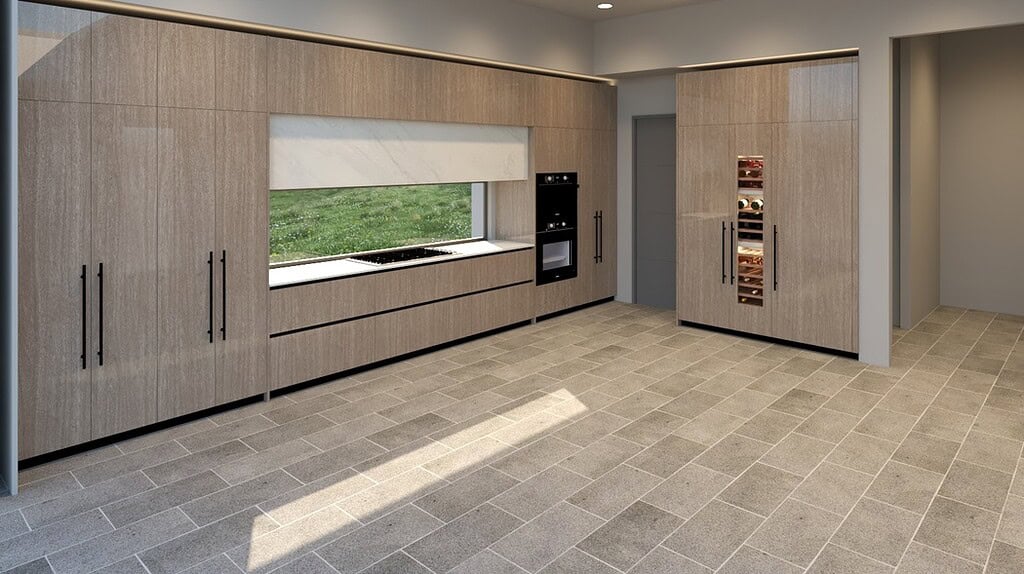
European cabinets are generally frameless. Doors and drawers attach directly to
the cabinet box, creating a more continuous exterior and wider access to the
interior.
This construction supports:
- Minimal gaps between doors and drawers
- Greater interior access
- Long, uninterrupted cabinet elevations
- Integrated appliances
- Handleless opening systems
- Floor-to-ceiling storage walls
- A more architectural appearance
At Foscari, we use these characteristics to develop cabinetry that feels connected
to the architecture rather than assembled as a series of individual cupboards.
Frameless Construction Versus Framed Construction
Construction is one of the clearest distinctions between European and traditional
cabinets.
Traditional Framed Cabinetry
Framed cabinetry includes a structural face frame around the front of the cabinet
box. The frame adds visual definition and provides a mounting surface for doors
and hinges.
This construction is often associated with:
- Inset or partial-overlay doors
- Visible stiles and rails
- Decorative moldings
- Furniture-inspired detailing
- More traditional architectural styles
European Frameless Cabinetry
Frameless cabinets eliminate the front face frame. Doors and drawers align
directly with the cabinet box, allowing the exterior to appear more continuous.
The absence of a face frame can also improve access to cabinet interiors,
particularly across paired doors and wide drawers.
Frameless construction is not simply a visual choice. It supports the precise
alignments, integrated storage, and architectural cabinet walls commonly found in
European interiors.
Clean Architectural Lines Versus Decorative Detailing
Traditional cabinetry often creates character through applied details. Crown
molding, raised panels, decorative legs, corbels, carved elements, and visible
hardware may all contribute to the design.
European cabinetry creates character through proportion, material, alignment, and
restraint.
Flat-panel fronts, narrow reveals, long drawer lines, and full-height cabinet walls
allow the cabinetry to read as part of the architecture.
This does not mean every European kitchen must look stark or monochromatic. The
cabinetry may incorporate:
- Warm natural wood
- Rich matte lacquer
- Expressive stone
- Smoked or clear glass
- Metal framing
- Integrated lighting
- Textured or fluted surfaces
The visual interest comes from the relationship between these materials rather
than from applied ornament.
The Foscari renderings show this range clearly, from light wood and white kitchens
to dramatic dark interiors with strong stone surfaces. Across the collection, the
cabinetry remains clean and architectural.
How Storage Access Differs
European cabinetry is typically designed around full-access interiors and
specialized organization.
Because there is no front face frame, drawer openings and cabinet interiors can be
used efficiently. Wide drawers are especially common because they provide a clear
view of cookware, dishes, pantry items, and utensils.
European storage options may include:
- Full-extension drawers
- Pull-out pantry systems
- Integrated waste and recycling
- Custom utensil inserts
- Plate and cookware dividers
- Interior lighting
- Retractable appliance zones
- Pocket-door breakfast stations
- Hidden charging locations
Traditional cabinetry can also include excellent interior accessories, but the
visible face frame may slightly reduce access at the front of some openings.
At Foscari, we plan storage around the homeowner’s routines. The objective is to
make every interior useful while preserving a calm exterior.
Cabinet Doors and Hardware
Door style is one of the most noticeable differences between European and
traditional cabinetry.
Traditional Cabinet Doors
Traditional cabinets frequently use:
- Raised-panel doors
- Recessed-panel doors
- Shaker-style fronts
- Applied molding
- Decorative knobs and pulls
Hardware often becomes part of the decorative composition.
European Cabinet Doors
European cabinets are commonly designed with flat or subtly textured fronts.
Opening systems may be visually minimal.
Options can include:
- Integrated grip channels
- Shaped door edges
- Recessed metal profiles
- Push-to-open systems
- Minimal linear pulls
These solutions preserve long, uninterrupted lines and allow the material itself
to remain the focus.
The operating system should still be selected for comfort and daily use.
Frequently used drawers may benefit from an integrated grip, while touch-latch
mechanisms may work well in selected storage areas.
Appliance Integration
European cabinetry is particularly well suited to integrated appliances.
Refrigerators, freezers, and dishwashers can be concealed behind panels matching
the surrounding cabinets. Ovens, coffee systems, and wine refrigeration can be
grouped within tall architectural walls.
This approach allows appliances to support the kitchen without visually
dominating it.
Traditional kitchens may feature freestanding ranges, visible refrigerators, and
decorative hoods as focal points. These appliances can contribute strongly to the
character of the room.
In a European kitchen, the design often takes the opposite approach. Large
appliances recede, while cabinetry, stone, wood, and architecture become more
prominent.
The Foscari renderings include numerous examples of ovens aligned within tall
cabinet walls and refrigeration visually absorbed into full-height storage.
Appliance models must be selected early because panel sizes, ventilation, door
swing, and technical requirements affect the cabinetry design.
Materials and Finishes
Traditional and European cabinets can both use high-quality materials, but they
often express those materials differently.
Traditional cabinetry commonly emphasizes painted wood, stained hardwood, visible
grain, furniture-style panels, and decorative glazing.
European cabinetry may use a broader architectural palette, including:
- Natural and engineered wood veneers
- Matte and high-gloss lacquer
- Textured laminates
- Fenix-style matte surfaces
- Glass cabinet fronts
- Metal and metallic finishes
- Stone and porcelain surfaces
- Concrete-inspired textures
These materials may continue across cabinet fronts, wall panels, islands, and
adjoining living-space storage.
Material selection at Foscari is developed in relation to the entire room.
Countertops, flooring, appliances, lighting, and architectural finishes are
considered together so the cabinetry feels cohesive rather than isolated.
Standard Sizes Versus Made-to-Measure Cabinetry
Many traditional cabinet lines are based on standard widths, heights, and depths.
Fillers, moldings, and trim are used to adapt those units to the room.
European systems may also use modular dimensions, but premium collections can
offer a greater degree of customization and made-to-measure production.
Made-to-measure European cabinetry can respond to:
- Unusual ceiling heights
- Long architectural walls
- Integrated appliance columns
- Concealed pantries
- Custom island proportions
- Windows, beams, and columns
- Whole-home cabinetry applications
This flexibility allows the cabinetry to feel designed for the architecture rather
than assembled from a limited set of boxes.
At Foscari, we help clients determine where made-to-measure customization will
provide meaningful functional or visual value and where a more standardized
configuration may be appropriate.
Differences in Kitchen-Island Design
Traditional kitchen islands often resemble freestanding furniture. They may
include decorative legs, framed doors, corbels, applied panels, and contrasting
paint or stain.
European islands are often treated as sculptural architectural volumes.
They may feature:
- Stone-wrapped surfaces
- Long horizontal drawer fronts
- Integrated cooktops or sinks
- Handleless storage
- Floating or recessed bases
- Integrated wood dining tables
- Contrasting material blocks
Several Foscari renderings show islands with dining surfaces incorporated directly
into the composition. Others use dark stone, wood, or monochromatic finishes to
create a strong central volume.
In both European and traditional kitchens, the island should be proportioned to
the room and planned around circulation, seating, appliances, and storage.
European Cabinetry in Open-Concept Homes
European cabinetry is especially effective in open-concept interiors because it
can relate closely to living-room furniture and architectural paneling.
Appliances can be concealed, countertops can remain visually quiet, and full-height
cabinet walls can resemble built-in furniture rather than conventional kitchen
storage.
Materials may continue into:
- Bars
- Media walls
- Dining-room storage
- Home offices
- Wardrobes
- Bathroom vanities
This creates continuity throughout the residence.
Traditional cabinetry can also work beautifully in open interiors, particularly
when the home has classical, transitional, or traditional architecture. In that
setting, decorative details may help connect the kitchen to millwork and furniture
elsewhere in the home.
The appropriate approach should support the architecture rather than compete with
it.
Installation and Technical Planning
European cabinetry typically requires a high level of technical planning and
installation precision.
Narrow reveals, full-height panels, integrated appliances, and continuous cabinet
runs make alignment especially visible.
The process may require:
- Professional field measurement
- Detailed plans and elevations
- Confirmed appliance specifications
- Coordination of plumbing and electrical systems
- Review of flooring and ceiling conditions
- Careful leveling and alignment
- Site-fitted panels and closures
- Final adjustment of doors and drawers
Traditional cabinetry also requires skilled installation, but decorative trim and
wider overlays may sometimes provide more flexibility when meeting irregular walls
or ceilings.
With European cabinetry, these variations are typically resolved through discreet
fillers, scribe panels, shadow gaps, and carefully planned tolerances.
At Foscari, installation is treated as the final stage of the design process, not
as a separate task.
Maintenance and Daily Use
Both European and traditional cabinets can provide excellent long-term performance
when the materials, hardware, and installation are appropriate.
European cabinets often have broad, uninterrupted fronts that are easy to wipe
clean. Handleless designs can reduce visual clutter, although touch-latch surfaces
may show fingerprints depending on the finish.
Traditional doors with grooves, profiles, and moldings may require more detailed
cleaning, particularly in active kitchens.
Daily performance depends on:
- The quality of hinges and drawer systems
- The durability of the selected finish
- Proper appliance ventilation
- Accurate installation
- Appropriate cleaning products
- Occasional hardware adjustment
At Foscari, we help clients evaluate finishes not only for appearance but also for
use, natural light, maintenance expectations, and the function of the room.
How the Investment May Differ
The cost of either European or traditional cabinetry can vary considerably.
Construction quality, materials, customization, hardware, appliances, project
scale, freight, and installation all influence the final investment.
European cabinetry may involve additional costs related to:
- International manufacturing and shipping
- Made-to-measure dimensions
- Specialty materials
- Integrated appliance panels
- Advanced interior organization
- Complex installation details
- Whole-wall architectural compositions
Traditional custom cabinetry can also represent a significant investment,
especially when it includes handcrafted details, specialty woods, custom finishes,
and extensive millwork.
The comparison should therefore be based on equivalent quality and scope rather
than style labels alone.
At Foscari, we help define the cabinet system, materials, and level of customization
according to the priorities of the project so the investment is directed where it
creates the greatest value.
Which Cabinet Style Is Right for Your Home?
European cabinetry may be the stronger choice when the homeowner prefers:
- Clean, modern architecture
- Minimal visible hardware
- Integrated appliances
- Full-height storage
- Customized interior organization
- Mixed wood, glass, stone, and metal finishes
- Cabinetry coordinated throughout the home
Traditional cabinetry may be more appropriate when the homeowner prefers:
- Decorative door profiles
- Visible knobs and pulls
- Inset or framed construction
- Furniture-style islands
- Crown molding and millwork details
- Classical or transitional architecture
Some homes benefit from a combination of influences. A contemporary kitchen may
include natural wood and warm materials, while a transitional interior may use
simplified doors and restrained detailing.
The most successful cabinetry is not defined by following one category rigidly.
It is defined by how well the design supports the architecture, lifestyle, and
desired atmosphere of the home.
Choosing European Cabinetry With Foscari
At Foscari Interiors, we specialize in helping Houston homeowners and project
professionals determine whether European cabinetry is the right fit for a kitchen,
bathroom, closet, office, living space, or whole-home project.
Our process considers:
- The architecture and dimensions of the home
- The desired level of customization
- Appliance and storage requirements
- Material and finish preferences
- Lighting and technical coordination
- Construction timing
- Delivery and installation
- The overall cabinetry investment
We guide the project from initial consultation and cabinet selection through
design development, field measurement, technical planning, ordering, delivery,
installation, and final adjustment.
European cabinetry offers a distinct approach: less emphasis on applied decoration
and more emphasis on architecture, proportion, material, and integrated function.
When those priorities align with the home, the result can feel calm, refined, and
highly personal.
Schedule a consultation with Foscari Interiors
to compare European cabinetry options for your Houston home.