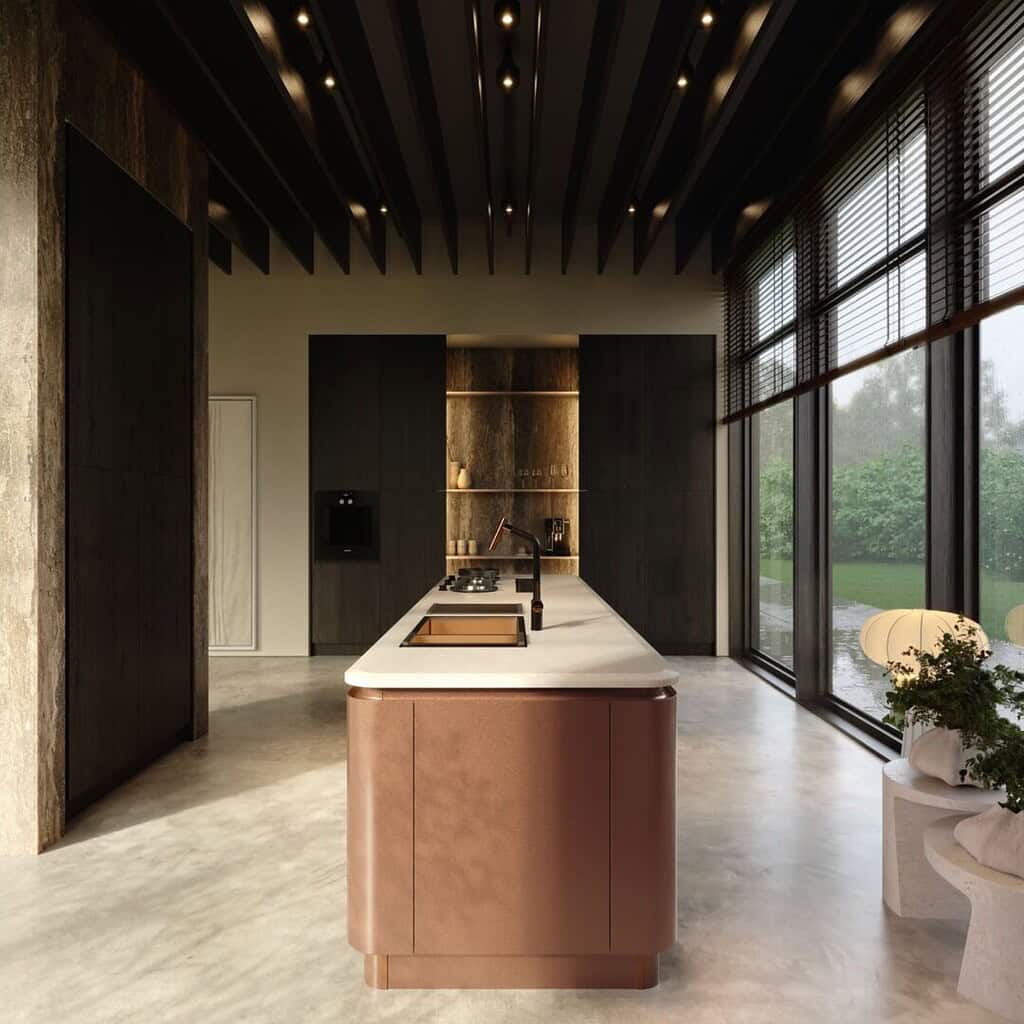
Italian kitchen design is a refined approach to creating kitchens that feel architectural, functional, and deeply considered. Although materials, lighting, appliances, and furniture all contribute to the finished space, cabinetry is usually the element that defines the design.
Italian kitchen cabinets are known for clean lines, precise proportions, sophisticated finishes, concealed storage, and seamless appliance integration. Rather than appearing as a collection of separate cupboards, the cabinetry is designed as a unified system that connects the kitchen to the architecture of the home.
At Foscari Interiors, Italian kitchen design begins with cabinetry tailored to the room, the homeowner’s lifestyle, and the surrounding interior. The result is a kitchen that feels elegant and visually calm while providing highly organized storage and exceptional everyday function.
What Defines Italian Kitchen Design?
Italian kitchen design is defined by the relationship between architecture, cabinetry, materials, proportion, and function.
The design is rarely based on decoration alone. Instead, it relies on carefully aligned cabinet fronts, sophisticated materials, efficient storage systems, and thoughtful transitions between cooking, dining, and living spaces.
Common characteristics of an Italian kitchen include:
- Modern frameless cabinetry
- Flat-panel cabinet doors
- Handleless or integrated opening systems
- Full-height cabinet walls
- Concealed appliances
- Organized drawer and pantry interiors
- Natural wood, lacquer, glass, stone, and metal finishes
- Large, sculptural kitchen islands
- Integrated lighting
- Made-to-measure layouts
These elements allow the kitchen to feel simple and visually composed, even when it contains extensive storage, advanced appliances, and multiple work zones.
The strongest Italian kitchens are not merely styled to look modern. They are planned as complete systems in which each component has a clear visual and functional purpose.
Cabinetry Is the Foundation of the Kitchen
Cabinetry is the defining element of Italian kitchen design because it occupies much of the room’s visible surface area and determines how the space functions.
Italian kitchen cabinets establish the visual rhythm of the room. The dimensions of doors, drawers, tall units, open shelves, and appliance panels are carefully coordinated to create balance and continuity.
Rather than placing individual cabinets wherever storage is needed, Italian kitchen design often treats the complete cabinet wall as an architectural composition. Refrigeration, pantry storage, ovens, coffee systems, and utility functions may all be integrated behind or within one continuous elevation.
This cabinetry-first approach allows countertops, backsplashes, lighting, and furnishings to relate to a strong and organized foundation.
It also creates an important distinction between Italian kitchen design and a kitchen assembled from a series of standard cabinets. The cabinetry is not simply fitted into the room. It helps define the room itself.
Clean Lines and Precise Proportions
Clean lines are one of the most recognizable features of Italian kitchen cabinetry.
Flat cabinet fronts, consistent spacing, and uninterrupted horizontal and vertical lines create a calm visual experience. The eye moves smoothly across the room without being interrupted by excessive molding, decorative overlays, or prominent hardware.
Precision is especially important because minimal cabinetry leaves every alignment visible. The relationship between doors, drawers, appliances, and surrounding panels must be carefully resolved.
Tall cabinets can emphasize ceiling height, while long drawer runs can make an island or wall appear wider. Repeated dimensions create rhythm, and carefully selected asymmetry may be used to create interest without introducing visual clutter.
These proportions help Italian cabinets feel more like custom architectural millwork or furniture than conventional kitchen storage.
Frameless Italian Cabinet Construction
Modern Italian cabinetry commonly uses frameless construction, which contributes to both its clean appearance and efficient use of space.
In a frameless cabinet, the door attaches directly to the cabinet box rather than to a separate face frame. This allows cabinet fronts to sit closely together and creates the narrow, consistent reveals associated with modern European kitchens.
Frameless construction can also provide more direct access to cabinet interiors. Drawers and storage accessories can use the available width efficiently, which is especially valuable in compact kitchens or highly organized work zones.
The clean geometry of the construction supports several characteristic Italian kitchen features, including:
- Full-width drawers
- Integrated appliance panels
- Continuous cabinet walls
- Handleless door systems
- Precisely aligned fronts
- Furniture-like proportions
Quality engineering and installation are essential. Doors and drawers must remain properly aligned so that the cabinetry maintains its refined appearance over time.
Handleless Cabinetry and Integrated Openings
Handleless cabinets are closely associated with modern Italian kitchen design. They allow the material, color, and proportions of the cabinetry to remain visually prominent.
Instead of decorative knobs or pulls, the cabinets may use:
- Integrated channel pulls
- Recessed grip profiles
- Push-to-open mechanisms
- Shaped door edges
- Concealed touch-latch systems
Integrated channels create a practical opening point while preserving a streamlined exterior. Push-to-open doors offer an even more minimal appearance, particularly on tall cabinet walls and less frequently used storage.
Handleless cabinetry can also improve circulation by removing projections from narrow walkways and compact work areas.
The opening system should be selected according to the homeowner’s preferences and daily habits. The most visually minimal option is not always the most appropriate for every cabinet or appliance.
Italian Cabinet Materials and Finishes
Italian kitchen cabinetry often creates visual interest through exceptional materials rather than applied decoration.
Because cabinet doors are typically simple in form, the grain, texture, color, and reflectivity of the finish become central to the design.
Natural Wood Cabinetry
Oak, walnut, and other wood veneers bring warmth and natural variation to the kitchen. Grain may be carefully aligned across multiple doors to create the appearance of one continuous surface.
Matte Lacquer Cabinets
Matte lacquer creates a soft and refined appearance. Warm white, taupe, gray, charcoal, and deep saturated colors can all be used to establish a calm, architectural palette.
Glossy Lacquer Cabinets
Glossy cabinetry reflects light and can create a brighter, more dramatic interior. It is often balanced with honed stone, natural wood, or other low-sheen materials.
Textured Cabinet Finishes
Textured wood, ribbed panels, stone-inspired surfaces, and tactile laminates add depth without relying on ornamental detailing.
Metal and Metallic Finishes
Stainless steel, bronze tones, champagne finishes, and other metallic surfaces can give Italian cabinetry a precise, sculptural character.
Glass Cabinetry
Smoked, tinted, clear, or textured glass may be used for display cabinets, illuminated shelves, and furniture-like storage.
The most successful Italian kitchen palettes use a limited number of carefully coordinated finishes. Each material is given enough visual space to be appreciated.
Concealed Storage and Interior Organization
Italian cabinetry supports a clean kitchen by placing extensive organization behind streamlined cabinet fronts.
The exterior may appear minimal, but the interior can be designed around cookware, pantry items, utensils, appliances, entertaining pieces, and household supplies.
Storage features may include:
- Deep full-extension drawers
- Custom utensil organizers
- Knife and spice inserts
- Pull-out pantry systems
- Plate and cookware dividers
- Concealed waste and recycling centers
- Tray and cutting-board storage
- Interior cabinet lighting
- Hidden charging stations
- Retractable appliance storage
This organization is not added only for convenience. It is essential to the aesthetic of the room. When appliances and everyday items have designated locations, countertops can remain clear and the cabinetry can retain its visual simplicity.
Thoughtful storage planning also improves workflow by placing items near the areas where they are most frequently used.
Seamless Appliance Integration
Appliance integration is another defining feature of Italian kitchen cabinetry.
Panel-ready refrigerators and dishwashers can be concealed behind cabinet fronts that match the surrounding design. This reduces visual interruptions and allows the kitchen to feel more like a furnished living environment.
Ovens, coffee systems, and wine refrigeration may be arranged within a full-height cabinet wall. Their positions can be aligned with surrounding doors and drawers to preserve a balanced composition.
Smaller appliances can be concealed inside dedicated cabinetry. Pocket or retractable doors may open to reveal a coffee station, breakfast area, or preparation zone, then close when the area is not in use.
Ventilation may also be incorporated into cabinetry, ceiling structures, or sculptural island elements.
Appliances should be selected early because their exact dimensions and technical requirements influence cabinet construction, electrical planning, ventilation, plumbing, and installation.
Architectural Cabinet Walls
Full-height cabinet walls are a hallmark of many Italian kitchens.
These walls may contain pantry storage, refrigeration, ovens, coffee systems, cleaning supplies, and access to concealed secondary spaces. When the doors are closed, the entire elevation reads as a unified architectural surface.
Cabinet walls can align with ceilings, nearby doorways, wall panels, and structural features. This allows the cabinetry to become integrated with the architecture rather than appearing as a separate object placed against it.
In some homes, a concealed door may lead to a walk-in pantry, preparation kitchen, laundry room, or utility area. Matching cabinet panels help the opening disappear into the composition.
This approach is particularly effective in open-concept homes because it reduces the visual presence of storage and appliances when the kitchen is viewed from surrounding living spaces.
Sculptural Italian Kitchen Islands
The kitchen island often becomes the centerpiece of an Italian kitchen.
Rather than appearing as a standard bank of cabinets with a countertop, the island may be treated as a sculptural volume. Stone, porcelain, wood, lacquer, or metal can be used to define its form and distinguish it from the surrounding cabinetry.
A modern Italian island may combine:
- Food preparation surfaces
- Cooking and ventilation
- Integrated sinks
- Deep drawer storage
- Wine or beverage refrigeration
- Casual seating
- Built-in dining surfaces
- Concealed electrical access
Waterfall stone ends can create a monolithic appearance, while an integrated wood table can add warmth and provide a comfortable transition between cooking and dining.
The island’s size should be based on the room and its circulation paths. Italian kitchen design emphasizes proportion, so a well-balanced island is more important than simply choosing the largest possible size.
Warm Minimalism in Italian Kitchens
Italian kitchen design is often minimal, but it does not need to feel cold or impersonal.
Warm minimalism combines streamlined cabinetry with natural materials, layered lighting, tactile finishes, and carefully selected furnishings.
Natural wood cabinetry can soften stone and metal. Warm white or taupe lacquer can create a quieter alternative to stark white. Leather seating, softly veined stone, brushed metal, and textured fabrics can bring additional depth to the room.
Open shelves or illuminated display cabinets may hold a restrained collection of ceramics, glassware, art, or meaningful objects. These elements introduce personality without overwhelming the cabinetry.
The objective is not to remove every decorative detail. It is to ensure that each visible element contributes to the atmosphere and composition of the kitchen.
Dark and Dramatic Italian Kitchens
Italian kitchen design is not limited to light or neutral palettes. A dark, dramatic kitchen can feel equally sophisticated when the cabinetry, materials, and lighting are approached with the same precision.
Matte black, charcoal, dark wood, and deep stone surfaces can be layered within a closely related tonal palette. Visual interest comes from changes in texture, reflectivity, and material rather than from contrasting decorative colors.
Matte black cabinets may be paired with expressive stone, smoked glass, warm timber, or metallic details. Lighting becomes especially important in a dark kitchen, since under-cabinet illumination, interior cabinet lighting, and carefully placed decorative fixtures help reveal depth and prevent the room from feeling visually heavy.
Material contrast can add warmth to a dark kitchen. A charcoal cabinet wall may be balanced with a wood island, pale flooring, or a softly veined stone surface. As with any Italian kitchen palette, restraint and precision are what keep a dark scheme feeling intentional rather than overwhelming.
Made-to-Measure Cabinetry
Made-to-measure design is central to the appeal of Italian cabinetry.
Cabinet dimensions can be developed around the actual ceiling height, wall conditions, windows, doors, appliances, plumbing, and electrical requirements of the room.
This makes it possible to create:
- Floor-to-ceiling storage
- Precisely proportioned islands
- Concealed walk-in pantries
- Integrated breakfast stations
- Custom appliance walls
- Built-in dining tables
- Cabinetry around unusual architectural conditions
- Coordinated storage in adjoining rooms
Custom planning can reduce the need for awkward filler panels and unresolved gaps. The cabinetry can appear intentionally connected to the room rather than adjusted to fit after the design is established.
Interior organization can also be personalized. Drawer depths, pantry systems, shelves, and accessories may be selected according to the homeowner’s possessions and routines.
Cabinetry That Connects the Entire Home
Italian cabinetry can continue beyond the kitchen and create a consistent design language throughout the residence.
A wood or lacquer finish used in the kitchen may reappear in a nearby bar, dining room cabinet, media wall, home office, or entry storage system.
This continuity is especially valuable in open-concept interiors, where several rooms are visible at once.
Italian cabinet systems can also be used for:
- Walk-in closets and wardrobes
- Bathroom vanities
- Home bars and wine rooms
- Living-room media walls
- Home offices
- Laundry and utility rooms
- Dining-room storage
- Architectural wall paneling
Repeating proportions, materials, and details helps the complete interior feel unified and intentionally designed.
Italian Cabinetry Compared With Standard Cabinets
Standard cabinets can be appropriate for straightforward projects, but Italian cabinetry offers a different level of design integration and personalization.
Important distinctions may include:
- Greater flexibility in dimensions and configurations
- More extensive material and finish options
- Precisely coordinated cabinet fronts
- Advanced interior storage systems
- Handleless and retractable opening options
- More seamless appliance integration
- Furniture-like detailing
- Continuity between kitchens and adjoining rooms
- Closer coordination with the architecture
The distinction is not simply one visual style versus another. It is the difference between treating cabinetry as a collection of individual storage boxes and treating it as a complete interior system.
This system-based approach is particularly valuable for homeowners who want a highly resolved kitchen or coordinated cabinetry throughout the residence.
Is an Italian Kitchen a Worthwhile Investment?
An Italian kitchen can be one of the most valuable investments homeowners make in their interiors because the cabinetry improves appearance, organization, and daily function at the same time.
Kitchen cabinets are used repeatedly throughout every day and occupy a large portion of the room’s visible architecture. Their quality affects how the kitchen looks, how easily it operates, and how well it supports cooking, entertaining, and household organization.
Thoughtfully designed Italian cabinetry can provide:
- More efficient storage
- Improved kitchen workflow
- Durable operating systems
- Better appliance integration
- A more cohesive interior
- Long-lasting visual appeal
- Greater daily enjoyment of the home
The value should be evaluated through the complete design rather than appearance alone. Cabinet construction, finish quality, hardware, technical planning, appliance coordination, and installation all contribute to the finished result.
When the cabinetry is tailored to the home and the homeowner’s routines, its benefits are experienced every day.
Designing an Italian Kitchen With Foscari
Italian kitchen design begins with a clear understanding of the architecture, cabinetry requirements, and lifestyle of the homeowner.
At Foscari Interiors, cabinetry can be considered alongside appliances, countertops, backsplashes, lighting, flooring, and adjoining rooms. This helps ensure that the kitchen feels like one complete composition rather than a collection of separately selected elements.
The design process may include:
- Reviewing architectural plans and room conditions
- Developing the cabinetry layout
- Planning appliance and storage integration
- Selecting cabinet materials and finishes
- Coordinating countertops and backsplashes
- Planning integrated lighting
- Creating technical drawings and visualizations
- Collaborating with architects, designers, and builders
- Coordinating cabinetry production and installation
Whether the desired interior is warm and natural, dark and dramatic, or quietly minimal, Italian cabinetry provides the flexibility to create a kitchen that feels highly personal and architecturally refined.
Ready to see these ideas applied to a real project? Explore Italian kitchen cabinets in Houston to learn how Foscari develops cabinetry, materials, and layout around each home.
Schedule a consultation with Foscari Interiors to explore Italian kitchen cabinetry tailored to your home.